
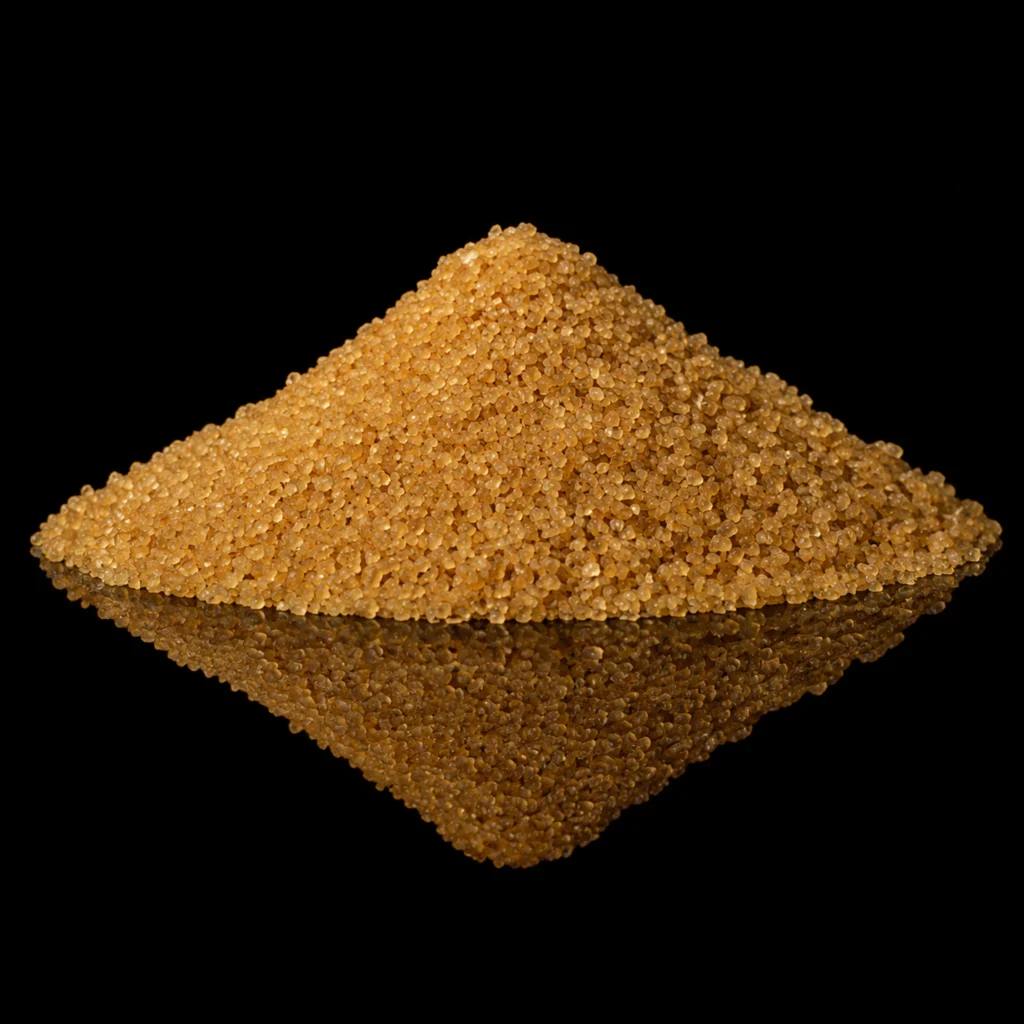
Demerara Sugar
Demerara sugar, made from sugarcane, composed of large grains and is light brown due to its natural molasses content. Demerara sugar is produced from sugarcane and consists of large grains which provide a nice, crunchy texture in baking.
What Is Demerara Sugar?
Demerara sugar is one of several types of sugar that are classified as “raw” sugars, along with turbinado sugar, as well as products described as raw cane sugar, washed sugar, evaporated cane juice, and others. Contrary to popular belief, raw sugars such as demerara do in fact undergo a high degree of refining. What the term “raw” indicates is that it has been crystallized only once, as opposed to twice for granulated white sugar. It’s named for the Dutch and then British colony in what is now Guyana where the sugar was first produced.
The traditional method for making demerara sugar is to chop up the sugar cane, extract its juice, then boil the liquid to produce a dark syrup, which is essentially unrefined molasses. This syrup is crystallized by adding seed crystals, and the crystallized syrup is spun in a centrifuge to separate the crystals from the molasses. It’s then washed to remove all but a trace amount of molasses. It’s poured through screens to filter out smaller particles, ensuring that the crystals have a uniformly medium coarseness, measuring between 0.5 and 0.3 mm. Demerara sugar is slightly sticky due to the trace amounts of molasses on it, but the crystals still flow freely and don’t clump together. It has a mildly caramel or toffee flavor but doesn’t taste particularly of molasses.
Not all demerara is made this way, however. Some demerara is made by spinning the sugar crystals and washing away all the molasses, sorting the crystals by size, and then adding a prescribed amount of molasses to the crystals.